

Choosing paint for your home may seem simple until you actually start looking at the options.
There are hundreds of colours, different types of paints, multiple finishes, interior and exterior products, washable paints, weather-resistant coatings, primers, waterproofing solutions and products designed for specific surfaces.
So, how do you choose the right paint for your home?
The right paint is not simply the colour that looks attractive in a shade card. A good paint should suit the surface, location, climate, lighting conditions and everyday usage of the space while providing the durability and finish you expect.
Your home’s walls are constantly exposed to different conditions. Interior walls may face stains, dust, fingerprints and moisture, while exterior walls have to withstand sunlight, rain, humidity, dust and changing weather.
Making the right choice can therefore improve not only the appearance of your home but also the protection and longevity of its surfaces.
This complete guide explains the most important things you should consider before choosing paint for your home.
Table of Contents
1. Start by Understanding Where the Paint Will Be Used
The first question should always be:
Where am I going to apply this paint?
Paint requirements can change significantly depending on the location.
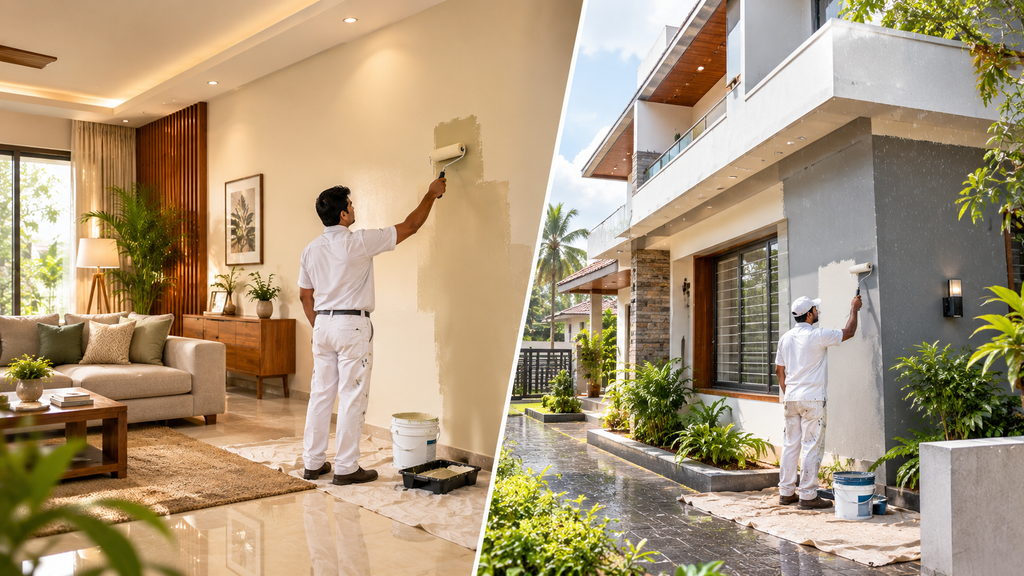
For example, the paint required for a living room is different from the coating needed for an exterior wall exposed to heavy sunlight and rain.
Broadly, house paints can be divided into two categories:
Interior Paint
Interior paints are formulated for walls and ceilings inside the home.
They are commonly used in:
- Living rooms
- Bedrooms
- Dining rooms
- Kitchens
- Hallways
- Children’s rooms
- Home offices
- Interior ceilings
Good-quality interior wall paint should provide an attractive finish while being suitable for everyday household conditions.
Depending on the room, useful characteristics can include washability, stain resistance, low odour, smooth finish and ease of maintenance.
Exterior Paint
Exterior walls experience much harsher conditions.
They may face:
- Strong sunlight
- UV exposure
- Rain
- Humidity
- Dust
- Pollution
- Temperature changes
- Algae or fungal growth
- Seasonal weather variations
Because of this, exterior paint should be specifically formulated for outdoor applications.
Never select paint based only on colour. Make sure the product itself is appropriate for the surface and environment.
2. Understand the Different Types of Paint
Knowing the basic paint categories makes choosing the right product much easier.
Emulsion Paint
Emulsion paint is one of the most popular choices for modern homes.
It is widely used because it can provide a smooth, attractive appearance and is available in a broad range of colours and finishes.
Different grades of emulsion paint are available for both interior and exterior applications.
Premium formulations may offer additional properties such as better washability, improved colour retention, stain resistance or enhanced weather protection.
When comparing emulsion paints, don’t compare only the price per litre.
Consider:
Coverage + Finish + Durability + Maintenance + Performance
A slightly higher-quality product may provide better long-term value if it requires less frequent repainting.
Enamel Paint
Enamel paints are generally chosen when a harder and more durable surface finish is required.
Depending on the specific product and application, enamel paint may be used on:
- Doors
- Windows
- Metal surfaces
- Wooden furniture
- Railings
- Grills
Enamel paints are available in different formulations and finishes.
Always verify that the particular enamel product is suitable for the material you intend to paint.
Primer
Primer is one of the most important parts of a good painting system.
Many homeowners focus entirely on the final colour, but the preparation underneath it can have a major influence on the finished result.
A suitable primer can help:
- Prepare the surface for painting
- Improve adhesion of subsequent coats
- Create a more uniform base
- Support better finishing
- Reduce uneven absorption on certain surfaces
The correct primer depends on the substrate and the topcoat being used.
A professional painting system should therefore be considered as a combination of surface preparation + primer + appropriate intermediate treatment + topcoat, rather than topcoat alone.
3. Check the Condition of Your Walls Before Choosing Paint
Even premium paint cannot compensate for poor surface preparation.
Before painting, inspect your walls carefully.
Look for problems such as:
- Cracks
- Dampness
- Water leakage
- Peeling paint
- Flaking
- Powdery surfaces
- Fungal growth
- Algae
- Uneven plaster
- Previous coating failure
These problems should be addressed before applying the final paint.
For example, if a wall is continuously becoming damp because of water leakage, simply repainting the surface may only hide the problem temporarily.
The source of the moisture should be identified and corrected first.
This is particularly important in areas such as bathrooms, kitchens, balconies, terraces and exterior walls exposed to rain.
Remember:
Good painting starts with good surface preparation.
4. Choose Paint According to the Room
Every room in your house serves a different purpose.
Therefore, using exactly the same paint specification everywhere may not always be the best approach.
Living Room
The living room is usually one of the most visible spaces in a house.
It is where families spend time together and where guests are often welcomed.
For living rooms, homeowners generally prefer paints that provide:
- Smooth finish
- Attractive appearance
- Good colour depth
- Easy maintenance
- Good durability
Neutral shades, warm tones and sophisticated colour combinations are popular because they can create a comfortable and welcoming environment.
Feature walls can also be used to add personality without overwhelming the entire room.
Bedroom
Bedrooms should generally feel relaxing and comfortable.
Popular bedroom colour families include:
- Soft blues
- Warm whites
- Beige
- Muted greens
- Pastels
- Soft greys
- Earthy tones
Rather than following trends blindly, choose a colour that creates the atmosphere you personally want.
Remember that the appearance of a colour changes depending on lighting.
Always test the shade on the actual wall before painting the whole room.
Children’s Room
Children’s rooms often experience more fingerprints, marks and everyday activity than other rooms.
For this reason, consider paints that are designed for easy cleaning and maintenance.
Colour choices can be more playful.
You might use combinations such as:
- Blue and white
- Yellow and grey
- Green and cream
- Peach and white
- Pastel combinations
However, avoid making every wall extremely bright.
A balanced combination of neutral walls and colourful accents can make the room easier to update as the child grows.
Kitchen
Kitchen walls may be exposed to:
- Cooking vapour
- Grease
- Moisture
- Food stains
- Frequent cleaning
Therefore, durability and cleanability become particularly important.
For areas where paint is appropriate, consider products designed to tolerate regular maintenance.
The areas directly behind cooking and washing zones may require more specialised surface solutions depending on the design of the kitchen.
Bathroom
Bathrooms experience frequent moisture and humidity.
Surface preparation and moisture management are particularly important here.
Before painting a bathroom wall, make sure there are no active leaks or dampness problems.
Use products that are specifically recommended by the manufacturer for the intended bathroom surface and exposure conditions.
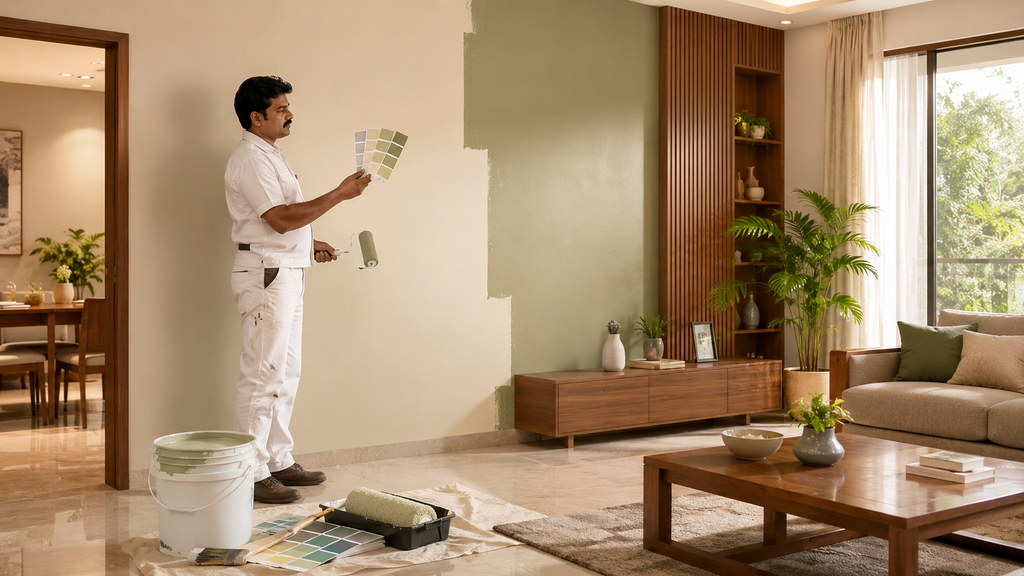
5. Understand Paint Finishes
Choosing the correct paint finish can completely change how a room looks.
Here are some common categories.
Matte Finish
Matte paint has very little shine.
It can provide an elegant and understated appearance.
Because it reflects less light, it can also be visually forgiving on certain surfaces.
However, cleaning characteristics vary considerably between products, so check the manufacturer’s specifications if washability is important.
Eggshell or Low-Sheen Finish
Low-sheen finishes provide a subtle amount of reflection without appearing highly glossy.
They can offer a good balance between appearance and practical maintenance depending on the product.
Satin Finish
Satin finishes generally have more sheen than matte or eggshell finishes.
They can create a smooth and polished appearance and are commonly considered for spaces where easier cleaning is desirable.
Gloss Finish
Gloss finishes reflect more light and create a noticeably shiny surface.
They are frequently used for selected wood and metal applications rather than every wall in a home.
The correct finish depends on the product, surface and desired appearance.
6. Consider Washability
A beautiful wall can quickly lose its fresh appearance when it develops stains, fingerprints and marks.
This is especially common in homes with children, pets or high-traffic areas.
If easy maintenance is important, look for paint specifically designed to provide good washability or stain resistance.
Washable paint can be especially useful for:
- Living rooms
- Children’s rooms
- Corridors
- Stairways
- Dining areas
- High-traffic walls
However, “washable” does not mean every paint can withstand aggressive scrubbing or harsh cleaning chemicals.
Always follow the cleaning recommendations supplied by the paint manufacturer.
7. Consider Your Local Climate
Climate plays an important role in exterior paint selection.
In places with strong sunlight, heavy rainfall or high humidity, exterior walls can experience significant environmental stress.
For hot and humid regions, for example, homeowners may want to look for exterior coatings designed with characteristics such as:
- UV resistance
- Weather resistance
- Colour retention
- Water resistance
- Resistance to algae or fungal growth
- Good adhesion
- Durable exterior performance
Always check the manufacturer’s technical specifications rather than assuming every exterior paint offers the same protection.
8. Choose Colours Based on Lighting
One of the biggest painting mistakes homeowners make is selecting a colour entirely from a small shade card.
Colour can look very different once applied to a large wall.
Natural and artificial lighting can dramatically influence how you perceive a shade.
A colour may appear different:
- In morning sunlight
- At noon
- During the evening
- Under warm lighting
- Under cool white lighting
- In rooms with limited natural light
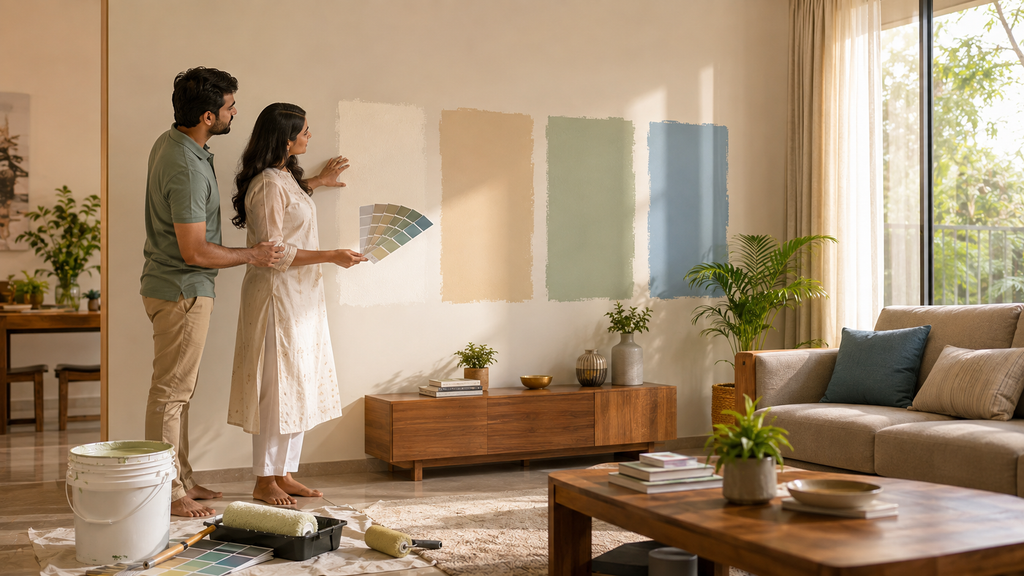
Therefore, test your shortlisted colour on a small section of the actual wall.
Observe it during different times of the day before making your final decision.
9. Consider the Size of the Room
Colour can also influence how spacious a room feels.
For Small Rooms
Lighter colours can often help create a brighter and more open visual effect.
Popular choices include:
- Off-white
- Cream
- Light beige
- Pale grey
- Pastel blue
- Soft green
Using similar colours across walls can also create a more continuous appearance.
For Larger Rooms
Larger spaces often provide more freedom to experiment with:
- Deeper shades
- Accent walls
- Colour combinations
- Contrasting tones
The goal is not simply to make a room look larger or smaller, but to create the atmosphere you want.
10. Think About Colour Psychology
Colours can influence the mood and character of a room.
Although colour preferences are personal, certain colours are commonly associated with particular atmospheres.
Blue
Often associated with calmness and relaxation.
Suitable for bedrooms, study areas and peaceful interiors.
Green
Can create a natural, fresh atmosphere.
Suitable for bedrooms, living rooms and workspaces.
Yellow
Often creates a cheerful and energetic impression.
It can work well as an accent or in selected social areas.
Red
A strong, energetic colour that can create visual impact.
It is often most effective when used thoughtfully rather than across every surface.
White
Creates a clean, bright and versatile background.
Different whites can have warm, cool or neutral undertones.
Grey
A flexible neutral that works with many modern interior styles.
The undertone of the grey is important because some greys lean warm while others appear cooler.
11. Don’t Ignore the Ceiling
The ceiling is sometimes called the “fifth wall” of a room.
Although white remains a popular ceiling colour, it is not the only option.
A slightly warmer or softer ceiling shade can complement the wall colours.
In selected interior designs, a contrasting ceiling can also become a decorative feature.
For smaller or darker rooms, lighter ceiling colours are often preferred because they help maintain a brighter appearance.
12. Choose a Colour Palette for the Entire Home
Instead of choosing every room independently, think about how colours will flow from one space to another.
A coordinated palette can make the entire house feel more thoughtfully designed.
One simple approach is to choose:
1 primary neutral + 1 secondary colour + 1 accent colour
For example:
Primary: Warm white
Secondary: Soft beige
Accent: Deep green
The same colours can then be used in different proportions throughout the home.
This creates variety while maintaining visual continuity.
13. Don’t Choose Paint Based Only on Price
It can be tempting to choose the cheapest paint available, especially when painting a large house.
However, the lowest purchase price does not always mean the lowest overall cost.
Consider factors such as:
- Recommended number of coats
- Coverage
- Surface preparation requirements
- Expected durability
- Washability
- Colour retention
- Maintenance
- Repainting frequency
Think in terms of long-term value, not only the price of the paint container.
14. Calculate the Required Paint Quantity
Buying too much paint can waste money, while buying too little can interrupt the project.
The quantity required depends on factors including:
- Total wall area
- Number of coats
- Surface condition
- Surface porosity
- Application method
- Product coverage
- Primer requirements
Paint manufacturers generally provide an estimated coverage range for each product.
Actual consumption can vary depending on the surface and application conditions.
For a more accurate estimate, calculate the total paintable area and compare it with the manufacturer’s stated coverage.
15. Always Test the Paint Before Finalising
A sample test is one of the easiest ways to avoid colour disappointment.
Apply the shortlisted colour to a reasonably sized section of the wall.
Then observe it during:
Morning → Afternoon → Evening → Artificial lighting
You may discover that a colour you loved on the shade card appears completely different in your room.
Testing first can save considerable time and money.
16. Surface Preparation Is Just as Important as Paint Quality
Imagine purchasing premium-quality paint and applying it over a dirty, damp or unstable surface.
Even an excellent topcoat may not perform as intended.
Before painting, the surface may need to be:
- Cleaned
- Dried
- Repaired
- Sanded
- Levelled
- Primed
Any loose or failing previous coating should be appropriately treated.
The exact preparation procedure depends on the existing surface and painting system.
Always follow the paint manufacturer’s application instructions.
17. Interior vs Exterior Paint: What’s the Difference?
Homeowners sometimes wonder whether the same paint can be used everywhere.
Generally, interior and exterior paints are formulated for different environments.
| Feature | Interior Paint | Exterior Paint |
| Main Environment | Indoor spaces | Outdoor surfaces |
| Weather Exposure | Limited | High |
| UV Exposure | Lower | Higher |
| Rain Exposure | Usually low | Potentially high |
| Cleaning Needs | Often important | Depends on system |
| Appearance | Major consideration | Appearance + protection |
| Climate Resistance | Usually less critical | Very important |
Always use a product specifically recommended for the intended application.
18. Questions to Ask Before Buying Paint
Before making your final purchase, ask your dealer, painter or paint professional:
- Is this paint suitable for interior or exterior use?
- What type of primer is recommended?
- How many coats are required?
- What is the approximate coverage?
- Is the paint washable?
- Is it suitable for the existing surface?
- What surface preparation is required?
- What finish will it provide?
- How long should I wait between coats?
- Are there specific application conditions I should follow?
- What maintenance is recommended?
- Is there a technical data sheet for the product?
These questions can help you compare products based on performance rather than marketing claims alone.
19. Common Mistakes to Avoid When Choosing House Paint
Choosing the right paint also means avoiding common mistakes.
Mistake 1: Selecting Colour Only From a Shade Card
Always test it on the actual wall.
Mistake 2: Ignoring Surface Problems
Repair cracks, dampness and coating failures before repainting.
Mistake 3: Using Interior Paint Outdoors
Choose a product formulated for exterior conditions.
Mistake 4: Skipping Primer Without Checking the System
Follow the recommended painting system for the particular surface and product.
Mistake 5: Choosing Only Based on Price
Consider coverage, durability, maintenance and expected service life.
Mistake 6: Ignoring Lighting
Always check your colour under natural and artificial light.
Mistake 7: Choosing Every Room Separately
Plan an overall colour palette to create better visual continuity.
20. How to Choose Exterior Paint for Your Home
Exterior paint has two important jobs:
Make your home attractive and help protect the exterior surface.
When selecting exterior paint, consider:
Weather Conditions
Choose a coating suitable for your local climate.
UV Exposure
Walls receiving strong sunlight may benefit from products formulated for improved UV and colour-retention performance.
Rain Exposure
For rain-exposed surfaces, select a suitable exterior coating system and make sure cracks, joints and water-entry points are correctly treated.
Surface Type
Different substrates may require different primers and preparation methods.
Colour
Exterior colours should complement the architectural design, roof, doors, windows and surrounding environment.
21. How to Choose Interior Paint for Your Home
Interior paint selection can focus more heavily on aesthetics and everyday maintenance.
Consider:
Room usage: How frequently is the room used?
Cleaning: Are the walls likely to need regular cleaning?
Lighting: How much natural light enters the room?
Atmosphere: Do you want the room to feel warm, calm, energetic, luxurious or minimal?
Finish: Would matte, low-sheen or another finish work best?
Existing décor: Consider furniture, curtains, flooring and other fixed elements.
A successful interior colour should work with the entire room rather than looking attractive only by itself.
22. How to Make Your Paint Last Longer
Once your home has been painted, simple maintenance can help preserve its appearance.
Follow these tips:
- Address water leaks quickly.
- Keep exterior drainage systems working properly.
- Avoid using harsh cleaning products unless approved for the paint.
- Clean stains using the recommended method.
- Inspect exterior walls periodically.
- Repair cracks before they become larger.
- Keep records of paint products and colour codes used in each room.
Keeping the exact shade code can be especially useful when you need future touch-ups.
23. A Simple Checklist for Choosing the Right Paint
Before purchasing paint, check the following:
✓ Interior or exterior application
✓ Surface condition
✓ Correct primer
✓ Desired finish
✓ Colour selection
✓ Lighting conditions
✓ Washability requirements
✓ Local weather conditions
✓ Product coverage
✓ Number of recommended coats
✓ Surface preparation requirements
✓ Maintenance needs
✓ Manufacturer application instructions
✓ Total project budget
If you consider all these factors, you are much more likely to achieve a beautiful and durable result.
Final Thoughts: How to Choose the Right Paint for Your Home
Choosing the right paint for your home is about much more than selecting a beautiful colour.
The best result comes from combining the right product, correct colour, suitable finish, proper surface preparation and professional application.
Start by understanding whether the surface is indoors or outdoors. Check the condition of your walls, choose a paint designed for the environment, select colours based on actual lighting and follow the recommended painting system.
Most importantly, don’t rush your decision.
A carefully selected paint system can transform an ordinary wall into an important part of your home’s design while helping the surface maintain its appearance for longer.
Whether you’re building a new home, renovating an old property or simply refreshing a single room, thoughtful paint selection can make a significant difference.
Choose the right paint. Choose the right colour. Prepare the surface properly. And give your home the finish it deserves.
Frequently Asked Questions (FAQ)
Which paint is best for home walls?
The best paint depends on whether the wall is indoors or outdoors, the surface condition, room usage, required finish and maintenance expectations. For interior walls, good-quality interior emulsions are commonly used. Exterior walls should use coatings specifically designed for outdoor weather exposure.
Which paint finish is best for interior walls?
There is no single finish that is best for every room. Matte finishes can create a sophisticated appearance, while low-sheen and satin-type finishes may provide different cleaning and appearance characteristics. Check the specifications of the particular product before choosing.
How do I choose the right paint colour?
Consider room size, natural light, artificial lighting, flooring, furniture and the atmosphere you want to create. Test the shortlisted colour on the actual wall and observe it throughout the day before finalising it.
Should I use primer before painting?
Primer requirements depend on the substrate, existing coating condition and selected topcoat. New, repaired or highly absorbent surfaces commonly require an appropriate primer. Follow the paint manufacturer’s recommended painting system.
What paint should I use for exterior walls?
Use an exterior coating specifically formulated for outdoor conditions. Depending on your climate and requirements, look for appropriate weather resistance, UV resistance, adhesion, colour retention and resistance to biological growth.
How many coats of paint are required?
The number of coats depends on the product, surface, existing colour, desired shade and preparation. Follow the manufacturer’s recommended application system rather than assuming the same number of coats for every project.
Is washable paint worth choosing?
Washable paint can be valuable in high-traffic areas or homes where walls are likely to develop fingerprints and stains. Compare the manufacturer’s washability and cleaning recommendations before buying.
How can I make exterior paint last longer?
Good surface preparation, suitable primer and topcoat selection, correct application and timely repair of water leakage or cracks can all contribute to better long-term performance.